Wednesday, 16 June 2010

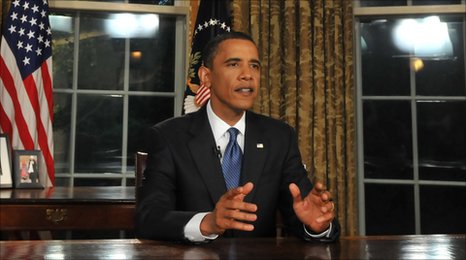
Oil spill: Obama to 'make BP pay'

Extract from BBC News Online, 16 June 2010

Mr Obama said he would meet company executives later and tell them that they must set up a fund to compensate those affected by the spill.

He described the spill as an assault on the shores and citizens of the US that tested the limits of human technology.

And he said it demonstrated the need to end the US "addiction" to fossil fuels.

Hours after the government sharply increased its estimate of how much oil was flowing into the Gulf from the broken well, Mr Obama warned that the risks of another such incident would continue to rise because "we're running out of places to drill on land and in shallow water".

He called on the Senate to pass an energy bill that has already cleared the House of Representatives.

Presidents use the Oval Office for what they regard as vital national issues.

The speech comes as opinion polls suggest a majority of Americans disapprove of how Mr Obama has handled the crisis - the worst environmental disaster in US history.

Click here to read the article in full.

Thursday, 10 June 2010

'Kick-ass' Obama attacks BP chiefs Hayward

From The Times, UK, 10 June 2010


BP may have hoped yesterday to boast of its first real progress in containing the leaking well at the bottom of the Gulf of Mexico.

Instead, it faced a harsh personal attack on its chief executive from President Obama and a devastating new report that called the company a “recurring environmental criminal”.

Even as US government analysts said that the top cap installed over the well last week was finally capturing up to three quarters of the oil rising to the well head, Mr Obama lashed out at Tony Hayward, saying that he would have fired him for a series of remarks that have already made the BP CEO a lightning rod for the growing fury of Gulf Coast residents.

“He wouldn’t be working for me after any of those statements,” Mr Obama said, when asked for his reaction to Mr Hayward’s claim last month that the environmental impact of the spill would be “very, very modest” and his admission that “I would like to have my life back”.

Mr Hayward will testify before Congress next week for the first time since the Deepwater Horizon explosion.

Mr Obama has frequently answered those who criticise his handling of the crisis by saying that his job is to solve the problem and co-ordinate the clean-up, rather than vent. However, he used an interview broadcast yesterday on NBC to do just that.

In the process, he revealed what appears to be a complete breakdown of trust between the White House and BP’s high command. Asked why he had not yet spoken directly to Mr Hayward, 49 days into the disaster, Mr Obama said: “Here’s the reason: because my experience is, when you talk to a guy like a BP CEO, he’s gonna say all the right things to me. I’m not interested in words. I’m interested in actions.”

Mr Obama also gave the clearest signal yet that his Administration may use evidence of negligence in the days and weeks before the blowout to build a criminal case against BP, potentially adding billions of dollars to the company’s liabilities.

“Initial reports indicate that there may be situations in which not only human error was involved, but you also saw some corner-cutting in terms of safety,” he told NBC’s Today Show.

The claim was supported by Courtney Kemp, the widow of one of the 11 men killed when the rig blew up. Testifying before Congress’s House Energy and Commerce Committee, Mrs Kemp said that her husband had been concerned for weeks before the explosion about the difficulties that engineers were having in controlling the well. “This well was different in the fact that they were having so many problems,” she said. “It was just kind of out of hand.”

The pressure to ensure that heads roll at BP will only mount with the publication of a new report on BP’s record of spills and accidents — the worst of any oil major operating in North America. The company pleaded guilty in 1999 to illegally dumping oil off the north coast of Alaska, failed to update vital equipment and safety systems at its Alaskan base in Prudhoe Bay and allowed a “fundamental culture of mistrust” to fester between workers and management there, according to the report by ProPublica, a non-profit research organisation.

“They are a recurring environmental criminal and they do not follow US health, safety and environmental policy,” Jeanne Pascal, a former lawyer for the US Environmental Protection Agency, told ProPublica.

Friday, 16 April 2010

Obama extends hospital visitation rights to same-sex partners of gays

Extract from the Washington Post, 16 April 2010

By Michael D. Shear

President Obama mandated Thursday that nearly all hospitals extend visitation rights to the partners of gay men and lesbians and respect patients' choices about who may make critical health-care decisions for them, perhaps the most significant step so far in his efforts to expand the rights of gay Americans.

The president directed the Department of Health and Human Services to prohibit discrimination in hospital visitation in a memo that was e-mailed to reporters Thursday night while he was at a fundraiser in Miami.

But opponents of same-sex marriage have called the visitation issue a red herring, arguing that advocates want to provide special rights for gays that other Americans do not have. A spokesman for one group said the president's move was part of a broader effort to appease gays and to undermine the institution of marriage.

Click here to read the article in full.

Wednesday, 24 March 2010

Israeli settlements: strong words from Hillary Clinton

BBC News Online, 22 March 2010

US Secretary of State Hillary Clinton has called on Israel to make "difficult but necessary choices" if it wants a peace agreement with the Palestinians.

Mrs Clinton warned that the status quo was "unsustainable" in a speech to a pro-Israel lobby group.

Her comments come amid a dispute between the US and Israel over plans for 1,600 new homes in East Jerusalem.

On Sunday, Israeli Prime Minister Benjamin Netanyahu ruled out halting settlement construction in the city.

The Palestinian Authority is furious at Israel's insistence on building on occupied territory. It sees it as a serious stumbling block to the resumption of talks, which have been stalled for more than a year.

Nearly 500,000 Jews live in more than 100 settlements built since Israel's 1967 occupation of the West Bank and East Jerusalem. They are held to be illegal under international law, though Israel disputes this.

In her speech to a convention in Washington of the influential Aipac (American Israel Public Affairs Committee), Mrs Clinton underscored the Obama administration's "rock solid" commitment to Israel.

"Guaranteeing Israel's security is more than a policy position for me. It is a personal commitment that will never waver," she said.

But, she added, it is Washington's "responsibility to give credit when it is due and to tell the truth when it is needed".

New construction in East Jerusalem or the West Bank "undermines mutual trust" and "exposes daylight between Israel and the United States that others in the region hope to exploit" she said.

Mrs Clinton has demanded Mr Netanyahu move to restore confidence in the peace process, including extending the suspension of new building in the West Bank to include East Jerusalem.

In a telephone call on Friday, the Israeli prime minister proposed a series of "trust-building measures" that represented "a real effort" to aid US peace efforts.

Although details have not yet been made public, Israeli officials say these include an agreement to discuss all outstanding issues in the indirect "proximity talks" being mediated by US special envoy George Mitchell.

However Israel will not discuss a freeze on settlement construction in Jerusalem.

"As far as we are concerned, building in Jerusalem is like building in Tel Aviv," Mr Netanyahu told his cabinet on Sunday.

But Mrs Clinton warned in her speech to Aipac that the "status quo is unsustainable for all sides" and "promises only violence and unrealised aspirations".

"There is another path - a path that leads toward security and prosperity for all the people of the region. It will require all parties including Israel to make difficult but necessary choices," she said.

Read the article in full here.

Monday, 22 March 2010

"A new presidency for Obama"

The House of Representatives approves the healthcare reform bill, something the Democrats had been trying to do since 1945 and that took centre stage in the White House agenda.


From El Pais, Spain, 22/03/2010

Antonio CaƱo, Washington

The acting leader of the House, David Obey, banged the gavel at 22.45 (03.45 CET) to announce that the Healthcare Reform Bill of the United States had been approved with 219 votes in favour against 212 against.

In the Oval Office, surrounded by his collaborators, Barack Obama lived the moment like the sound of bell-ringings, the type of glory that is worth the most brutal of political battles. The Bill may not be officially assured yet, but the future of Obama's Presidency is.

For American society, the gavel brought to an end a day which had been memorable, both in terms of the drama and the emotions that led to it, as well as for the monumental consequences that will follow the vote.

Around 32 million uninsured will now be provided health coverage through the state. This will be the end for the tyranny of those private health insurers who impose unfair premiums and conditions. The Government will help small businesses who cannot offer their staff health insurance and will set penalities for those who refuse to provide coverage. Also, relationships with doctors and hospitals will be reviewed and healthcare will be guaranteed to both children and the young unemployed.

In a nutshell, the gavel heralded a huge step forward in the direction of better social justice and, symbolically, a massive blow against the Republicans, who tried every possible startegy to derail the reform. The majority of Democrats decided to finally lend their support in spite of the persistent warnings from the opposition (as well as some opinion polls) that the bill could prove electorally costly.

A last minute deal was struck with around ten pro-life Democrats led by Congressman Bart Stupak - President Obama will sign an executive order guaranteeing that no public funds will be used for abortions. This proved crucial to secure the last necessary votes.

Last night, along with the Bill, the House voted a series of amendments to be added to the text once it secures the Senate's approval. The Republicans could delay the process, but can no longer stop the Bill which simply needs the President's signature to be completed.

This success heralds a new presidency for Obama. Concluded the long and winded process that led to the Health Bill approval, the US President is a new man. Accomplished a mission that absorbed all his energy, he has now the opportunity to achieve other domestic goals (the Energy Bill, education reforms, the Immigration Bill, etc) as well as play a bigger role in foreign affairs.

Few presidents have had such a clear opportunity of boosting their mandate at this stage because few presidents have been at the core of an event of such magnitude. This is the equivalent of 9/11 for George W Bush, a landmark event that turned him from moderate politician into a fanatical neo-con.

March 21 won't turn Obama into a previously unseen version of himself. More likely, it will signify the making of an incredible candidate and a fully fledged president.

In the run-up to the 2008 election, Obama conceded in an interview that nobody studies to become president and that it's a job you only learn by actually doing it. And he's acted like an amateur for most of the time he's spent in the White House. Someone with good intentions and good ideas, willful and confident, but with evident lack of experience.

Without the help of a seasoned Washington professional such as Nancy Pelosi, the dream of a Healthcare Reform would long ago have died a premature death.

On the other side, without Obama's vision and the prominence that he gave this Bill as his number one priority, this project would have fallen into the same black holes that sucked in all of his predecessors'.

The debate taught Obama a few things that may prove useful in the long term. One, for instance, is the President's isolation. Obama learnt that no Congress member, including those most loyal to his party, would ever risk their career to save the President. Until the end of February, when Obama took full responsibility for the Bill, negotiations had ground to a standstill.

Also, Obama learnt that bipartisanship is a beautiful concept but not an easy one to pull off. Since last summer, the Republicans spotted the Healthcare Reform Bill as the President's Achille's heel and went for the jugular. Yesterday, the Republican's leader in the House, John Boehner, warned that "this war isn't over".

Saturday at Capitol Hill, Obama made his best pitch for health reform: "we are proud of our individualism, we are proud of our liberty, but we also have a sense of neighborliness and a sense of community and we are willing to look out for one another and help people who are vulnerable and help people who are down on their luck and give them a pathway to success and give them a ladder into the middle class".

(link to original article)

[Translated by myself as best I could].

US House passes key healthcare reform bill

Extract from BBC News Online, 22 March 2009

The US House of Representatives has narrowly voted to pass a landmark healthcare reform bill at the heart of President Barack Obama's agenda.

The bill was passed by 219 votes to 212, with no Republican backing, after hours of fierce argument and debate.

It extends coverage to 32 million more Americans, and marks the biggest change to the US healthcare system in decades.

"We proved that we are still a people capable of doing big things," Mr Obama said in remarks after the vote.

"This legislation will not fix everything that ails our healthcare system, but it moves us decisively in the right direction," he said.

Mr Obama is expected to sign the legislation into law shortly.

But a new challenge is expected in the Senate, where Democrats hope amendments to the bill will be enacted by a simple majority. Republicans say the move is unconstitutional and plan to stop it.

Historic vote

This is the most significant victory for the president since he took office 14 months ago, says BBC North America editor Mark Mardell.

He has been tough and tenacious - some might say stubborn - in pushing this legislation after so much opposition and so many setbacks, our correspondent says.

When the vote count hit the magic number of 216 - the minimum needed to pass the bill - Democrats hugged and cheered in celebration and chanted: "Yes we can!"

Under the legislation, health insurance will be extended to nearly all Americans, new taxes imposed on the wealthy, and restrictive insurance practices such as refusing to cover people with pre-existing medical conditions will be outlawed.

The bill's final approval represented a stunning turnaround from January, when it was considered dead after Democrats lost their 60-seaty majority in the Senate, which is required to defeat a filibuster.

To avoid a second Senate vote, the House also approved on Sunday evening a package of reconciliation "fixes" - agreed beforehand between House and Senate Democrats and the White House - amending the bill that senators adopted in December.

The White House plans to launch a campaign this week to persuade sceptical Americans that the reforms offer immediate benefits to them and represent the most significant effort to reduce the federal deficit since the 1990s.

According to the Congressional Budget Office, the healthcare bill will cut the federal deficit by $138bn (£92bn) over 10 years.

[Read the article in full here]

Sunday, 14 March 2010

Obama aide condemns 'destructive' Israeli homes plan

From BBC News Online, 14 March 2009

Israel's announcement of plans to build 1,600 homes for Jews in East Jerusalem was "destructive" to peace efforts, a top aide to Barack Obama says.

David Axelrod said the move, which overshadowed a visit to Israel by US Vice-President Joe Biden, was also an "insult" to the United States.

Israel's prime minister has tried to play down the unusually bitter diplomatic row between the two allies.

US Secretary of State Hillary Clinton last week issued her own stern rebuke.

Mrs Clinton told Israeli Prime Minister Benjamin Netanyahu by telephone on Friday that the Israeli move was "deeply negative" for US-Israeli relations.

'Affront'

Under the Israeli plans, the new homes will be built in Ramat Shlomo in East Jerusalem.

The international community considers East Jerusalem occupied territory and says Israel's building there is illegal under international law. But Israel regards East Jerusalem - which it annexed in 1967 - as its territory.

The Palestinians are threatening to boycott newly agreed, indirect talks unless the Ramat Shlomo project is cancelled.

"This was an affront, it was an insult but most importantly it undermined this very fragile effort to bring peace to that region," David Axelrod, one of President Obama's closest aides, told NBC television.

"We have just started proximity talks, that is shuttle diplomacy, between the Palestinians and the Israelis, and for this announcement to come at that time was very destructive," he said.

At a cabinet meeting on Sunday, Mr Netanyahu began by giving a survey of media coverage of the spat with the Americans.

"I propose not to be carried away and to calm down," he said. "We know how to handle these situations, calmly, responsibly and seriously."

He went on to admit that the announcement of project during the vice-president's visit had been offensive, but it had been an accident.

Mr Netanyahu has now set up a committee of senior officials to vet the timing of such announcements.

However, the BBC's Paul Wood, in Jerusalem, says it is clear the Americans are not persuaded that this was all just a bureaucratic mix up.

The ill-timed announcement on settlements has allowed Mr Netanyahu to shore up his right-wing coalition, our correspondent says.

But Israel needs the US to deal with Iran's nuclear programme - and that is an issue which Mr Netanyahu himself has said is more important than any other facing Israel.

Close to 500,000 Jews live in more than 100 settlements built since Israel's 1967 occupation of the West Bank and East Jerusalem. They are illegal under international law, although Israel disputes this.

The Quartet of Middle East peace mediators - the US, Russia, the EU and the UN - has also condemned the Israeli housing announcement and said it would review the situation at its ministerial meeting scheduled for 19 March in Moscow.

Thursday, 25 February 2010

Barack Obama lays out case for health reform in live debate

The Independent (UK), 25 February 2010

President Barack Obama both wooed and blasted Republicans who have impeded his health care plan in an extraordinary live TV summit today.

He called the meeting with the aim of breaking a partisan deadlock over his top domestic priority.

And with the unprecedented, day-long policy debate available from start to finish to a divided public, Mr Obama and Democratic leaders cast the reform they want as critical to tackling an issue that is even more pressing to many Americans - the struggling economy.

Passing a version of the bill that Republicans managed to block despite solid Democratic majorities in Congress also is critical to the president's political future and that of his party ahead of congressional elections in November.

With that in mind, Mr Obama was trying to boost support from moderate Democratic politicians, who could face the wrath of conservative voters if they back their president's plan.

"We all know that this is urgent," Mr Obama said.

At stake is the Democrats' stalled legislation to extend coverage to more than 30 million people who are now uninsured.

Polls show Americans want their elected leaders to address the problems of high medical costs, eroding access to coverage and uneven quality. But the public is split over the Democrats' sweeping legislation, with its trillion-dollar, 10-year price tag and many complex provisions.

For Mr Obama, the summit is his chance to make a compelling closing argument to the American people. If he succeeds, Democrats will push ahead to pass the legislation with a package of revisions he's proposed. If he falters, another Democratic president will have been humbled by health care. He will have to appeal to both sides to at least give him a modest bill smoothing some of the rough edges from the current system.

Mr Obama lamented the partisan bickering that has stalled the health care legislation. "Politics I think ended up trumping practical common sense," he said. But, he noted, "everybody here understands the desperation that people feel when they're sick. And I think everybody here is profoundly sympathetic and wants to make sure that we have a system that works for all Americans."

And yet, even as he pleaded for cooperation he acknowledged agreement may not be possible. "I don't know that those gaps can be bridged," Mr Obama said. "If not, at least we will have better clarified for the American people what the debate is all about."

Both chambers of Congress passed separate bills last year. But before the two versions could be reconciled, Republicans captured the Massachusetts Senate seat in a special election to replace the late Edward Kennedy. That cost Democrats the 60-vote supermajority needed to overcome Republican procedural obstacles and pass major legislation.

Public scepticism about the health care plan was seen as contributing to the Republican victory in Massachusetts, an overwhelmingly Democratic state. With the supermajority lost and Democrats getting nervous, the White House had been expected to shift its attention to job creation, an issue more likely to resonate with voters.

Disagreements were not always expressed diplomatically today.

Republican Senator Lamar Alexander challenged Mr Obama's claim that insurance premiums would fall under the Democratic legislation. "You're wrong," he said. The president responded: "I'm pretty certain I'm not wrong."

Despite losing their supermajority, Democrats can still pass major health legislation by using special budget rules that require only a simple majority. They have been reluctant to use that process so far because it would enrage Republicans and further worsen the partisan divide.

Another alternative if bipartisan agreement eludes Mr Obama today is going smaller, with a modest bill that would merely smooth some of the rough edges from the current system.

The White House developed the slimmed-down health care proposal so the president will know what the impact would be if he chooses that route, according to a Democratic official familiar with the discussions.

Thursday, 28 January 2010

Analysis: Barack Obama the underdog

Extract from The Times (UK), 28 January 2010

By

Barack Obama has had to come down from the Olympian heights to recast himself as a street fighter, even an underdog - and he did it well.

His political task last night was to gloss over a thin record of accomplishment and chart a course towards midterm elections in November that a deeply demoralised Democratic party is starting to dread.

He admitted he and his team had made mistakes in their first year even if most of the errors were left unspecified other than a failure to communicate his aims for health reform.

But he did not abandon his big goals on health, financial reform or climate change and made the Republicans look like the party of "no".

And the key line from the speech was one of defiance: "We do not give up. We do not quit. We don’t allow fear or division to break our spirit.”

Few of his supporters would have forecast such a shrunken agenda a year ago, when Mr Obama’s sweeping promises of change still seemed equal to the monumental challenges posed by a collapsing economy. Since then recovery has been sluggish, unemployment has been stuck at 10 per cent and Republican efforts to sabotage health, financial and energy legislation have been relentless.

But aides said Mr Obama had lost none of his ambition and still planned to change the way Washington does business – but in reality he is more dependent than ever on the 535 members of Congress who crammed into the House of Representatives last night.

Obama's State of the Union speech

US President Barack Obama has said in his first State of the Union address that creating jobs must be the nation's number one focus.

Mr Obama accepted Americans were "hurting" and that his election pledge of change had not come quickly enough.

He defended his healthcare reform efforts and bank bailout policy, but said there would be a spending freeze from 2011 to tackle the budget deficit.

Bob McDonnell, for the Republicans, criticised the expansion of government.

The Virginia governor said the federal government was "simply trying to do too much".

'Devastation remains'

Mr Obama was given the traditional warm welcome by all sides of Congress and received several standing ovations.

He opened his address by saying the US had to "answer history's call".

On the issue of employment, Mr Obama said: "People are out of work. They are hurting. They need our help. And I want a jobs bill on my desk without delay.

"Jobs must be our number one focus in 2010."

Read a full transcript of Obama's speech here.

Sunday, 24 January 2010

Obama announces dramatic crackdown on Wall Street banks

Obama's 'new Glass-Steagall Act' will prevent banks with customer deposits taking risky investment bets

Extract from the Guardian (UK), 21 January 2010

by Jill Treanor

President Barack Obama today declared his intent to take on Wall Street by announcing plans for stringent rules on the banking sector that prompted comparisons with the draconian regulations introduced after the Great Depression.

In the boldest move taken by any government around the world to respond to the financial crisis, Obama told banks they would no longer be able to take risky bets with their own capital to make money on the financial markets.

Banks which take deposits will not be allowed to use their own money to take bets on markets, run hedge funds or make private equity investments through what he called the "Volcker rule" after former Federal Reserve chairman Paul Volcker.

He also wants to prevent further consolidation of the financial system in the US and will ban takeovers and mergers among American firms in the sector.

Obama said the new proposals would keep taxpayers from being "held hostage" by banks that have become "too big to fail" and that pose a risk to the entire financial system.

Wall Street was nervous ahead of the announcement, with the Dow Jones Industrial Average down more than 160 points before he spoke and then falling a further 40 points once he had finished. The FTSE 100 index in London fell sharply in afternoon trading as the markets feared the impact on UK banks such as Barclays and RBS.

"We simply cannot return to business as usual," said Obama.

Click here to read the article in full

Friday, 22 January 2010

What a week this anniversary

Mark Mardell, BBC News Online, 22 January 2010

Timothy Geithner, Barney Frank, President Obama, Paul Volcker

What a week. This anniversary of the president's year in office was always going to be a time for reflection.

The victory of Scott Brown in Republican-resistant Massachusetts turned it into a time for urgent reassessment for the president's party. The word "pivotal" has been used

a fair bit. That's right. After twelve months the President has swung on his heel.

This may be, as many commentators contend, the beginning of the end for a one-term, flash-in-the-pan President. This is the third victory in a row for Republicans and they are on a roll. It certainly hints to sweeping Republican victories in November's mid-term elections.

But it may be just the kick the president and his party needed. After that stunning victory and the adulation that followed, he assumed his popularity gave him political invincibility. Although he has been accused of governing from further left than some expected, at heart he's a pragmatist.

He got his head down and got on with the new, serious, difficult and no doubt fascinating business of running the most powerful country in the world.

This week may have reminded him that these days, and especially in America, the political campaign can never stop. The most important thing about power is what you do with it. But a very close second is making sure you keep it.

There have been immediate changes. Whether they like it or not, the Democrats' number one priority, health care, has just slipped dramatically down the agenda.

Scott Brown's election left them with few options. The two main ones have now been ruled out. The president has said the plan must not be pushed through the Senate before Mr Brown takes his seat. Nancy Pelosi has said the Senate bill won't get enough votes in the House.

This surely means that healthcare reform, as currently proposed, is finished.

They deny it is dead, but it is certainly in a coma, only to be wakened if some Republican senators have an unlikely epiphany.

This will be very disappointing for some who voted for Obama. But many on the left thought the plan was too watered down to be worth much.

The opinion polls suggest a more complex picture than simply people hating the idea of any reform, but the current plan had become politically toxic.

The two bills are just too confusing, and the Democrats haven't tried to sell them clearly. I heard a fascinating piece on NPR this morning, an economist trying to convince a union member that taxing her Cadillac plan wouldn't hurt her.
His argument rested on the belief that her company would raise wages if it was forced to adopt a less expensive plan. Not surprisingly, she wasn't convinced.

Then there is the president's radical plan for the banks. This looks like a dramatic policy shift. The White House says it was signed off before Christmas, so I'll just observe that by an amazing coincidence it is a perfect fit for this week's narrative.

The president has christened the new plan, so offensive to many big banks, the Volcker rules after former chairman of the Federal Reserve Tall Paul. This is kind of the president because by all accounts Paul Volcker had all but given up on his plan ever being adopted. Treasury Secretary Tim Geithner was apparently opposed. Now it seems he's been overruled.

The president knows getting this through congress will be hard. But this isn't a messy vote loser in the country. This is a populist clarion call.

He's predicting a swarm of lobbyists will descend on Capitol Hill and he's doing a good impression of a man relishing the scrap ahead.

He'll hope the American people will be cheering him on. He has called on Republicans to join in designing common sense rules to protect ordinary Americans.

They may well deride his plan as another example of government interference, but they are in a sticky position and they know it.

One senator has dismissively said he is creating a "bogeyman". But I bet it is a bogeyman that frightens many of his voters.

The Supreme Court ruling raises another spectre. Banks that feel threatened can spend their money running ads against the new laws.

There may be a torrent of them. But they will have to put their names on them, rather than saying "This advert was paid for by Americans for a nicer America" as happens at the moment. They will have to be very clever adverts to avoid public distain.

The White House no longer seems complacent in the face of bad opinion polls, disastrous elections and a re-invigorated Republican party. Late in the day, they are accepting the battle is serious and returning to the fray.

Mark Madell's article was originally published here.

Wednesday, 20 January 2010

Republicans take Ted Kennedy's seat in dramatic upset

Democrats lose Senate seat in Massachusetts, throwing Obama's health reform plan into doubt

From the Guardian, UK- Ewen MacAskill, 20 January 2009

The Republicans have produced one of the biggest political upsets of recent US history by winning Ted Kennedy's Senate seat in Massachusetts, traditionally one of the safest Democratic states in the country.

The victory against the odds came on the eve of the anniversary today of Barack Obama's inauguration, a heady time for the Democrats when they entertained hopes of a prolonged period of dominance.

The win robs the Democrats of their filibuster-proof 60-40 majority in the Senate and throws into doubt the future of Obama's health reform plan. Obama and the Democratic leadership will have to decide whether to take another look at the bill.

Scott Brown, a truck-driving National Guardsman who was virtually unknown even in Massachusetts a few weeks ago, beat Martha Coakley, the state attorney general who had expected to inherit the seat, by 52% to 47%.

Brown, in his victory speech, referred to one of the decisive moments of the campaign, when in a debate Coakley referred to "Ted Kennedy's seat". Brown said: "This Senate seat belongs to no one person, to no political party … This is the people's seat."

Coakley, in her concession speech, said: "I am heartbroken at the result, as I know you are, and I know we will get up together tomorrow and continue this fight, even with this result tonight."

It is a huge psychological blow to the Democrats: the seat of John F Kennedy and then Edward Kennedy until his death last year is now in Republican hands. If a seat regarded by Democrats as one of the safest in the country can fall, then scores of Democrats standing in the congressional mid-term elections in November will see themselves as also vulnerable.

"It is a shock, a total shock," said David Hadas, 37, one of more than a thousand Coakley supporters at a Boston hotel for what they hoped would be a celebration.

"It is only a year ago everyone was very upset with the Republican party and we swept Obama into office."

Voters, citing reasons for the shift to the Republicans, repeatedly expressed hostility towards the healthcare bill but also a belief that Obama represented too much government interference, was too leftwing and was spending too much.

The Democrats have several Plan Bs for the health bill, none of which they regard as satisfactory. One was to vote on the bill before Brown takes up his seat but Jim Webb, a Democratic senator, appeared to block that last night by saying the election had been both about heathcare and the integrity of the government process.

More than 2,000 Republicans turned up at another Boston hotel last night to noisily celebrate a rare victory after heavy defeats in the 2006 congressional elections and again in 2008 for the White House.

"I pray this will be the start of a bloodless revolution, the start of the campaign against the Obama agenda, in which the silent majority are heard," David Knight, 43, a Republican from neighbouring Rhode Island, said. "We hope this is the end of the health bill but they could still ram it through."

Michael Nicolazzo, 26, who was also at the party, was a Democrat until two years ago but felt Obama was too left wing. "This was a referendum on Obama. For the bluest of all states to elect a Republican, it really sends a message that people do not want extravagant spending." He, too, hoped the health bill will be killed.

Brown received a lot of backing from Republicans who had travelled to join him from all round the US, and also from grassroots groups that have grown up in opposition to Obama's agenda, particularly on health, such as the Tea Party.

At the Boston hotel where the Democrats held their wake, some began crying as the first results came through. Most headed home early.

"We are all in shock," said Addrienne Walker, 40, who was still carrying a Coakley poster. "We have not had a Republican in that seat since 1952." She hoped Obama would not back off on health reform but admitted that the November elections would be tough. "It is not looking good. Obama is going to have a fight on his hands."

Even before polling closed, the Democrats were engaged in a blame game. The White House and the national leadership hinted that Coakley had been responsible because she had fought too low-key a campaign.

Obama issued a relatively terse statement, thanking Coakley for her hard work.

Local Democrats blamed the national leadership, saying they had been too slow in recognising the danger and providing the necessary campaign cash and staff. They accused the national leadership of having pushed for the negative ads in the final days and claimed this had alienated independents.

A third candidate, Joe Kennedy, representing the Libertarians, took only 1%. He is no relation to the late senator.

Sunday, 20 December 2009

Senate healthcare bill set to pass by Christmas

Democrats' compromise on abortion with Nebraska's Ben Nelson gives them the 60 votes to fight off GOP filibusters. Obama calls it 'a major step forward for the American people.'

Extract from the Los Angeles Times, 20 December 2009


Reporting from Washington - After a dramatic month of sometimes round-the-clock negotiating and deal-making, Senate Democrats came together Saturday behind sweeping healthcare legislation, providing a powerful boost for President Obama's top domestic policy goal.

The breakthrough came after Senate Majority Leader Harry Reid (D-Nev.) and his lieutenants engineered a delicately crafted compromise to prevent federal funding of abortions, the same issue that nearly stopped the House from passing its healthcare bill six weeks ago.

With the deal, Nebraska Sen. Ben Nelson, a strong opponent of abortion, became the 60th and crucial last member of the Democratic caucus to line up behind the healthcare legislation.

That paved the way for Reid to introduce a final package of changes to his 2,074-page bill and file the necessary procedural motions that should allow Democrats to quash an expected series of Republican filibuster attempts over the next several days. The Senate now remains on track to pass its version of the bill by Christmas.

"Today is a major step forward for the American people," Obama said Saturday afternoon at the White House as a thick layer of snow blanketed the capital. "After a nearly century-long struggle, we are on the cusp of making healthcare reform a reality."
Read the full article here.

Joss Garman: Copenhagen - Historic failure that will live in infamy

From the Independent, UK, 20 December 2009

The most progressive US president in a generation comes to the most important international meeting since the Second World War and delivers a speech so devoid of substance that he might as well have made it on speaker-phone from a beach in Hawaii. His aides argue in private that he had no choice, such is the opposition on Capitol Hill to any action that could challenge the dominance of fossil fuels in American life. And so the nation that put a man on the Moon can't summon the collective will to protect men and women back here on Earth from the consequences of an economic model and lifestyle choice that has taken on the mantle of a religion.

Then a Chinese premier who is in the process of converting his Communist nation to that new faith (high-carbon consumer capitalism) takes such umbrage at Barack Obama's speech that he refuses to meet – sulking in his hotel room, as if this were a teenager's house party instead of a final effort to stave off the breakdown of our biosphere.

Late in the evening, the two men meet and cobble together a collection of paragraphs that they call a "deal", although in reality it has all the meaning and authority of a bus ticket, not that it stops them signing it with great solemnity.

Obama's team then briefs the travelling White House press pack – most of whom, it seems, understand about as much about global-climate politics as our own lobby hacks know about baseball. Before we know it, The New York Times and CNN are declaring the birth of a "meaningful" accord.

Meanwhile, a friend on an African delegation emails to say that he and many fellow members of the G77 bloc of developing countries are streaming into the corridors after a long discussion about the perilous state of the talks, only to see Obama on the television announcing that the world has a deal.

It's the first they've heard about it, and a few minutes later, as they examine the text, they realise very quickly that it effectively condemns their continent to a century of devastating temperature rises.

By now, the European leaders – who know this thing is a farce but have to present it to their publics as progress – have their aides phoning the directors of civil society organisations spinning that the talks have been a success.

A success? This deal crosses so many of the red lines laid out by Europe before this summit started that there are scarlet skid marks across the Bella Centre, and one honest European diplomat tells us this is a "shitty, shitty deal". Quite so.

This "deal" is beyond bad. It contains no legally binding targets and no indication of when or how they will come about. There is not even a declaration that the world will aim to keep global temperature rises below C. Instead, leaders merely recognise the science behind that vital threshold, as if that were enough to prevent us crossing it.

The only part of this deal that anyone sane came close to welcoming was the $100bn global climate fund, but it's now apparent that even this is largely made up of existing budgets, with no indication of how new money will be raised and distributed so that poorer countries can go green and adapt to climate change.

I know our politicians feel they have to smile and claim success; they feel that's the only way to keep this train on the tracks. But we've passed that point – we need to go back to first principles now. We have to admit to ourselves the scale of the problem and recognise that at its core this carbon crisis is, in fact, a political crisis.

Until politicians recognise that, they're kidding themselves, and, more than that, they're kidding us too.

Not all of our politicians deserve the opprobrium of a dismayed world. Our own Ed Miliband fought hard, on no sleep, for a better outcome; while Brazil's President Luiz Inacio Lula da Silva offered to financially assist other developing countries to cope with climate change, and put a relatively bold carbon target on the table. But the EU didn't move on its own commitment (one so weak we'd actually have to work hard not to meet it), while the United States offered nothing and China stood firm.

Before the talks began, I was of the opinion that we would know Copenhagen was a success only when plans for new coal-fired power stations across the developed world were dropped. If the giant utilities saw in the outcome of Copenhagen an unmistakable sign that governments were now determined to act, and that coal plants this century would be too expensive to run under the regime agreed at this meeting, then this summit would have succeeded.

Instead, as details of the agreement emerged last night, we received reports of Japanese opposition MPs popping champagne corks as they savoured the possible collapse of their new government's carbon targets.

It's not just that we didn't get to where we needed to be, we've actually ceded huge amounts of ground. There is nothing in this deal – nothing – that would persuade an energy utility that the era of dirty coal is over. And the implications for humanity of that simple fact are profound.

I know we Greens are partial to hyperbole. We use language as a bludgeon to direct attention to the crisis we are facing, and you will hear much more of it in the coming days and weeks. But, really, it is no exaggeration to describe the outcome of Copenhagen as a historic failure that will live in infamy.

In a single day, in a single space, a spectacle was played out in front of a disbelieving audience of people who have read and understood the stark warnings of humanity's greatest scientific minds. And what they witnessed was nothing less than the very worst instincts of our species articulated by the most powerful men who ever lived.

Joss Garman is a Greenpeace activist and co-founder of Plane Stupid

Sunday, 8 November 2009

Abortion was at the heart of wrangling

Extract from The New York Times, Sun 8 Nov 2009

By David Herszenhorn and Jackie Calmes

WASHINGTON — It was late Friday night and lawmakers were stalling for time. In a committee room, they yammered away, delaying a procedural vote on the historic health care legislation. Down one floor, in her office, House Speaker Nancy Pelosi desperately tried to deal with an issue that has bedeviled Democrats for more than a generation — abortion.

After hours of heated talks, the people she was trying to convince — some of her closest allies — burst angrily out of her office.

Her attempts at winning them over had failed, and Ms. Pelosi, the first woman speaker and an ardent defender of abortion rights, had no choice but to do the unthinkable. To save the health care bill she had to give in to abortion opponents in her party and allow them to propose tight restrictions barring any insurance plan that is purchased with government subsidies from covering abortions.

The restrictions were necessary to win support for the overall bill from abortion opponents who threatened to scuttle the health care overhaul.

The results of that fight, waged heavily over two days, were evident as one liberal Democrat after another denounced the health care plan because of abortion restrictions, even though they were likely to hold their noses in the end and vote for the bill itself.

“If enacted, this amendment will be the greatest restriction of a woman’s right to choose to pass in our careers,” said Representative Diana DeGette, Democrat of Colorado, one of the lawmakers who left Ms. Pelosi’s office mad.

Representative Rosa DeLauro, Democrat of Connecticut, said the bill’s original language barring the use of federal dollars to pay for abortions should have been sufficient for the opponents. “Abortion is a matter of conscience on both sides of the debate,” Ms. DeLauro said. “This amendment takes away that same freedom of conscience from America’s women. It prohibits them from access to an abortion even if they pay for it with their own money. It invades women’s personal decisions.”

But Ms. DeGette, Ms. DeLauro and other defenders of abortion rights said they would nonetheless vote in favor of the health care bill and fight for changes in the final version, to be negotiated with the Senate.

The fight over abortion foreshadows difficult soul searching in the months ahead as Democratic lawmakers confront deepening divisions among their caucus on issues like abortion rights and gun control.

Through the 1980s, the Democrats struggled over abortion. But by the 1990s, the share of Americans supportive of abortion rights had grown. Democrats lost their majorities for 12 years, leaving the most liberal and pro-abortion rights members in office. As a result it seemed to fade as a public issue. Now, however, Democrats once again have a large and diverse House majority, with more members from conservative-leaning districts where anti-abortion rights groups are active.

It was that division that played out behind the scenes late last week, and into the weekend, and came powerfully in the open as the issue.

Click here to read the New York Times article in full.

US House backs healthcare reforms

From BBC News Online, 8 Nov 2009

The US House of Representatives has backed a healthcare bill in a step towards reforms promised by President Obama, despite strong opposition.

Passed in a narrow 220-215 vote, the bill aims to extend coverage to 36 million more Americans and provide affordable healthcare to 96%.

The Senate now has to pass its own bill and the two must then be reconciled before the programme can become law.

Mr Obama has made healthcare reform a central plank of his domestic agenda.

He described Saturday's vote in the House as "historic", saying he was "absolutely confident" the Senate would follow suit.

Correspondents say the legislation could lead to the biggest changes in American healthcare in decades.

Concessions

The bill was supported by 219 Democrats and one Republican - Joseph Cao from New Orleans. Opposed were 176 Republicans and 39 Democrats.

Mr Obama said: "The United States Senate must follow suit and pass its version of the legislation. I am absolutely confident it will, and I look forward to signing comprehensive health insurance reform into law by the end of the year."

The debate had sparked strong emotions on both sides.

Democratic Party representative John Dingell said: "[The bill] offers everyone, regardless of health or income, the peace of mind that comes from knowing they will have access to affordable healthcare when they need it."

But Republican representative Candice Miller said: "We are going to have a complete government takeover of our healthcare system faster than you can say `this is making me sick'."

Before Saturday's vote, Mr Obama had made a rare visit to Congress to try to persuade wavering members of his own Democratic Party to back the bill.

He said such opportunities came around "maybe once in a generation".

After the vote, the speaker of the House, Nancy Pelosi, said: "I thank the president for his tremendous leadership, because without President Obama in the White House, this victory would not have been possible."

The bill will allow the government to sell insurance in competition with private companies and make insurers offer cover to those with pre-existing conditions.

However, the government-run healthcare programme - the so-called "public option" - was scaled back in the run-up to the vote.

One key concession to get the bill through was to anti-abortion legislators.

An amendment was passed that prohibits coverage for abortion in the government-run programme except for rape, incest or if the mother's life is threatened. Private plans can still offer the cover.

Republican Bart Stupak, who sponsored the amendment, said: "Let us stand together on principle - no public funding for abortions."

Abortion rights supporters said the amendment was the biggest setback to their cause in decades.

A Senate debate on healthcare reform is expected in the coming days.

Senate majority leader Harry Reid said after the House vote: "We realise the strong will for reform that exists, and we are energised that we stand closer than ever to reforming our broken health insurance system".

Sunday, 11 October 2009

Obama earns plaudits from the LGBT community

From El Pais, Spain, 11 October 2009

US President and Peace Nobel Prize Barack Obama, tried on Saturday (Sunday at dawn in Europe) to reassure the LGBT community with an impassioned defence of his commitment for equality. "My commitment with you is unswerving, do not doubt the advances that we're going to make, I'm here with you in that fight", Obama reassured during a speech at the Human Rights Campaign, the biggest organisation defending LGBT rights in the United States.

The community, which decisively backed Obama in last year's elections - and that repeatedly expressed frustration for what they consider has been minimal progress to favour their cause- replied to his words with an ovation. Joe Solmonese, President of the Human Rights Campaign, went as far as defining the night as "historic".

Like he'd stated on previous occasions, Obama reiterated his pledge to end the ban on homosexuals serving openly in the military. The current policy, passed under Bill Clinton in 1993 and known as "Don't Ask Don't Tell", allows homosexuals to serve in the armed forces as long as they don't disclose their sexual orientation.

Regarding the thorny issue of same-sex marriage, the president - who last June timidly granted certain rights to LGBT public servants - vowed to repeal of the Defense of Marriage Act, which discriminates against homosexuals as regard the legality of same-sex unions and other rights. "I'll end all that", he insisted, "and the moment will come when we as a nation will finally recognise that relationships between two men or between two women are as right, real, and admirable as those between men and women".

[note: the article originally appeared in Spanish. This is my translation]

"Change we can't believe in"

Extracts from Mehdi Hasan's article from the New Statesman (UK), Oct 8 2009.

"Barack Obama promised a sharp break from the Bush era, yet he seems to have stepped into the shoes of his disgraced predecessor. As the anniversary of his election approaches, Mehdi Hasan investigates what went wrong".

"The distance between Obama and Bush on a host of policies is not as great as many people might hope or have expected - and it appears to get narrower by the day. This should not, perhaps, come as a huge surprise. One reason for continuity between US presidents - even those who are, on the surface, as different as Bush and Obama - is the nature of the modern imperial presidency, at the apex of a bloated national-security state. As the historian Garry Wills pointed out recently in the New York Review of Books, the president 'is greatly pressured to keep all the empire's secrets . . . he becomes the prisoner of his own power . . . a self-entangling giant'".

Click here to read the article in full.

Friday, 9 October 2009

Obama wins 2009 Nobel Peace Prize

From BBC News Online, 9 October 2009

US President Barack Obama has won the 2009 Nobel Peace Prize.

The Nobel Committee said he was awarded it for "his extraordinary efforts to strengthen international diplomacy and co-operation between peoples".

The committee highlighted Mr Obama's efforts to strengthen international bodies and promote nuclear disarmament.

There were a record 205 nominations for this year's prize. Zimbabwe's prime minister and a Chinese dissident had been among the favourites.

The laureate - chosen by a five-member committee - wins a gold medal, a diploma and 10m Swedish kronor ($1.4m).

"Only very rarely has a person to the same extent as Obama captured the world's attention and given its people hope for a better future," the Norwegian committee said as the prize was announced.

"His diplomacy is founded in the concept that those who are to lead the world must do so on the basis of values and attitudes that are shared by the majority of the world's population."